
Brand Mascots Are Back, and They're More Than a Pretty Face
While character-led branding has existed for over a century, a recent decade dominated by sterile minimalism and hyper-templated design systems quietly pushed many legacy mascots off the stage. They were dismissed as dated novelty items—tools designed to sell cheap commodities rather than build long-term brand equity.
Today, they are making a massive comeback, and their operational mandate has completely changed.
The Revival
Duolingo's chaotic green owl, Duo, is the clearest proof that brand mascots never died; they just needed a modern reason to exist. What began as a mildly passive-aggressive push notification transformed into a viral cultural icon, driven less by visual design and more by uninhibited, unhinged behavior across digital feeds.
This resurgence is a direct reaction to industry fatigue. As brands spent years stripping away personality in pursuit of clean grids, geometric typography, and corporate credibility, they sacrificed something vital: emotional warmth. A logo commands recognition, but a mascot builds affinity.
That distinction drives real enterprise value. While a wordmark or color palette can be refreshed overnight, a mascot builds equity through predictable, ongoing behavior that audiences actively anticipate. It gives a brand a conversational bridge that design guidelines alone cannot deliver—a character to be tagged, meme-ified, defended in comment sections, and shared across group chats.
What changed isn't the mascot itself, but its job description. Historically, a mascot existed inside a 30-second television spot: you saw it, you smiled, and it disappeared when the broadcast ended. In today's decentralized media landscape, control is gone. Brands live in continuous social streams where characters must react in real time, voice distinct opinions, and maintain a consistent identity on a random Tuesday afternoon.
Duolingo's owl joined the conversation after Bad Bunny's Super Bowl halftime show with a playful, trend-savvy meme.
Why Audiences Connect
Humans are hardwired to prioritize faces over abstract shapes. Apple leaned on that instinct this past March, when it quietly introduced Lil Finder Guy, a small blue-toned character with an oversized head, to promote the MacBook Neo. The mascot's design borrows directly from the Finder app's old Happy Mac icon, and it landed at exactly the right cultural moment: gen Z and Alpha audiences have developed a real appetite for blind-box collectibles like Smiski and Labubu, and for the rounded, colorful Frutiger Aero aesthetic that defined tech in the early 2000s. What's surprising is that a brand known for tightly controlled messaging let this one grow almost entirely through fan interpretation, trusting the character to make a famously polished company feel, briefly, a little silly and a lot more human.
The strategy extends far beyond consumer tech:
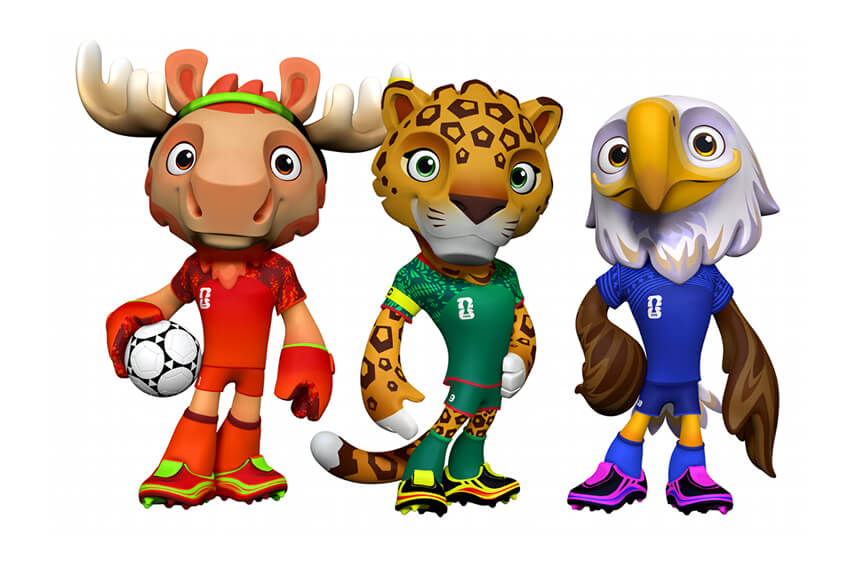
- Translation of Big Ideas: Since 1966, FIFA has used World Cup mascots to translate abstract concepts—unity, host national pride, and global athletic passion—into tangible cultural touchpoints. For the 2026 World Cup, characters like Maple the Moose (Canada), Zayu the Jaguar (Mexico), and Clutch the Bald Eagle (USA) turn host-nation heritage into immediate, collectible consumer connections.
- Simplifying Complex B2B Systems: Mailchimp's Freddie demonstrates that mascots aren't limited to consumer goods. By putting a humanized face on technical marketing software, Freddie softens user onboarding and transforms complex software education into an inviting, approachable conversation.
Where AI Fits In
Generative AI enables teams to generate character concepts from a single prompt in seconds. But speed creates saturation: as the barrier to visual output drops, the market gets noisier and far more generic. Anyone can generate a character face; very few can craft a character identity that holds long-term narrative value.
Leading agencies treat AI as an efficiency tool for production and scale, not a replacement for strategy. AI allows brand characters to scale real-time interactions across dynamic channels without losing voice consistency. However, while AI can process scale, it cannot engineer brand strategy, cultural context, or genuine human nuance.
Is a Mascot Right for Your Brand?
A mascot isn't a universal fix. If a company possesses deep legacy equity, relies on executive thought leaders, or operates with an ultra-minimalist brand positioning, adding a character can create friction rather than clarity.
Furthermore, launching a mascot requires long-term commitment. A character demands dedicated creative governance—copywriters, animators, and strategists who understand how to maintain voice, tone, and visual cohesion over years of execution.
Strategy First, Execution Second
The return of the brand mascot represents a broader evolution in integrated marketing: audiences demand brands that feel human, responsive, and culturally aware.
Determining whether a character aligns with your market positioning—and engineering one capable of building long-term equity—requires a rigorous strategic foundation. Unique Image specializes in guiding brands through high-impact brand architecture, character development, and omnichannel strategy to build identities that resonate and endure.
Give Your Brand a Face
Discover how Unique Image can help you determine whether a character fits your brand, and build one designed to endure
Start the Conversation